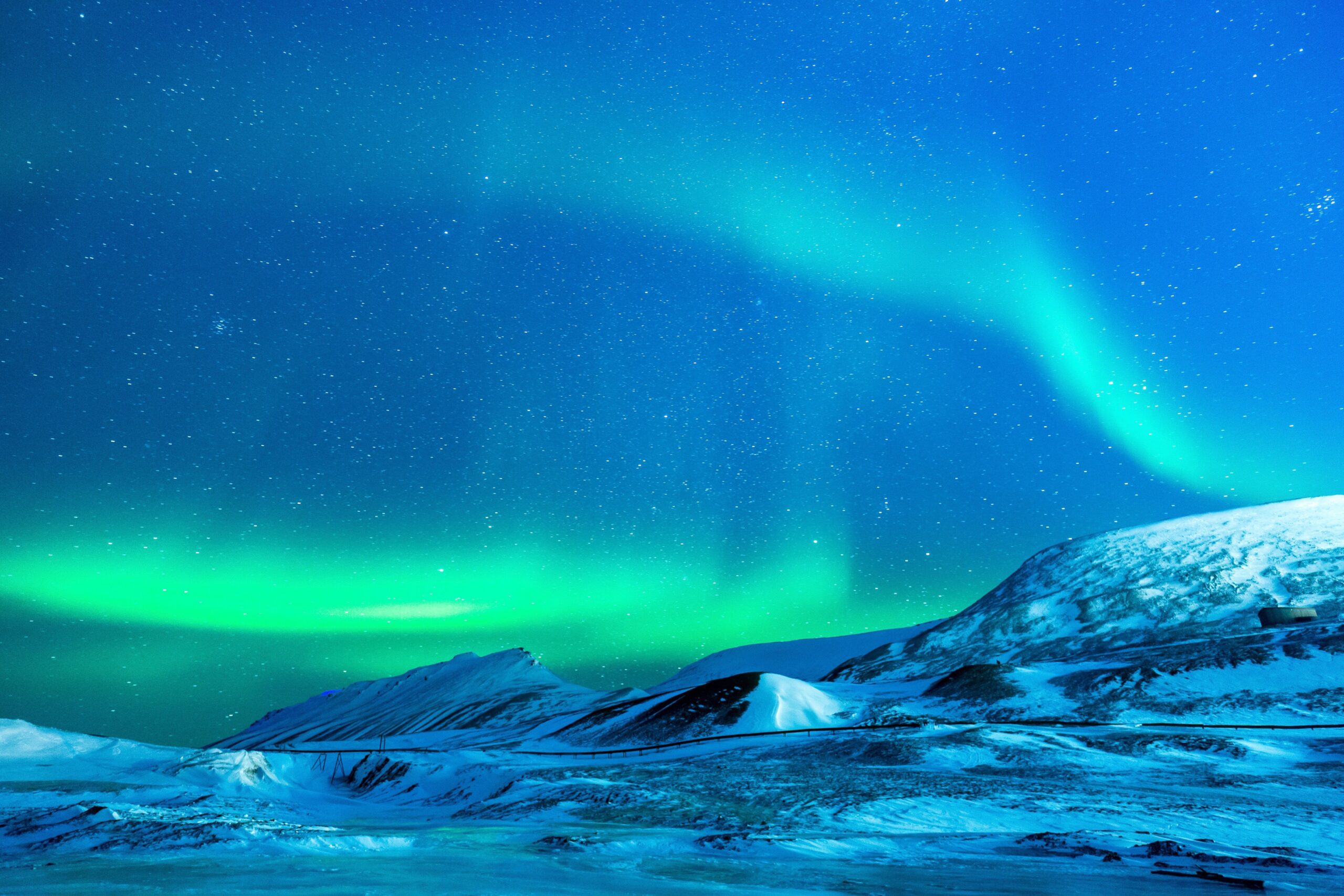
Mammals that change from darker summer to white winter coats, like lemming, hare, and fox, are starting to experience a “mismatch” in the timing of their color change with a changing climate. But be careful! You won’t find another iconic white animal in this section. Polar bears are considered marine mammals by biologists! Why? They depend solely on the ocean for their habitat and food.
Reindeer/Caribou
In North America and Greenland, the species Rangifer tarandus is known as “caribou”. This same species is called “reindeer” in Eurasia. In many Arctic nations, large herds are managed as free-ranging livestock. In Scandinavia, these semi-domesticated reindeer/caribou can even outnumber wild populations!
Wild reindeer/caribou herds can sometimes get so large that they overgraze the lichen they depend on. As they deplete their food source, the population crashes. As the forage quality recovers, so does the population. We know about these large fluctuations in part because Indigenous Peoples have long documented these ups and downs.
Although reindeer/caribou herds are expected to go up and down, the sustained reduction in many populations since the 1990s is unprecedented. For migratory herds (making the longest terrestrial migrations on earth!) this is likely due to climate change, as plants adapt to warmer temperatures and more rain-on-snow events occur. Infrastructure and development can also hinder movements between winter range, calving grounds, and summer range.
These migrations are important not only for a functioning ecosystem (as reindeer transfer nutrients and support food webs) but are woven into the culture of Arctic Peoples. Reindeer/caribou provide food security in a harsh climate and contribute to local economies.
There are several variants, or subspecies, of reindeer/caribou that show unique behaviors and have a different appearance based on their local landscape. These variants are also called “ecotypes” since they can be defined by the ecosystem as well as genetics. There are four main ecotypes: migratory tundra, Arctic islands, mountain, and forest.
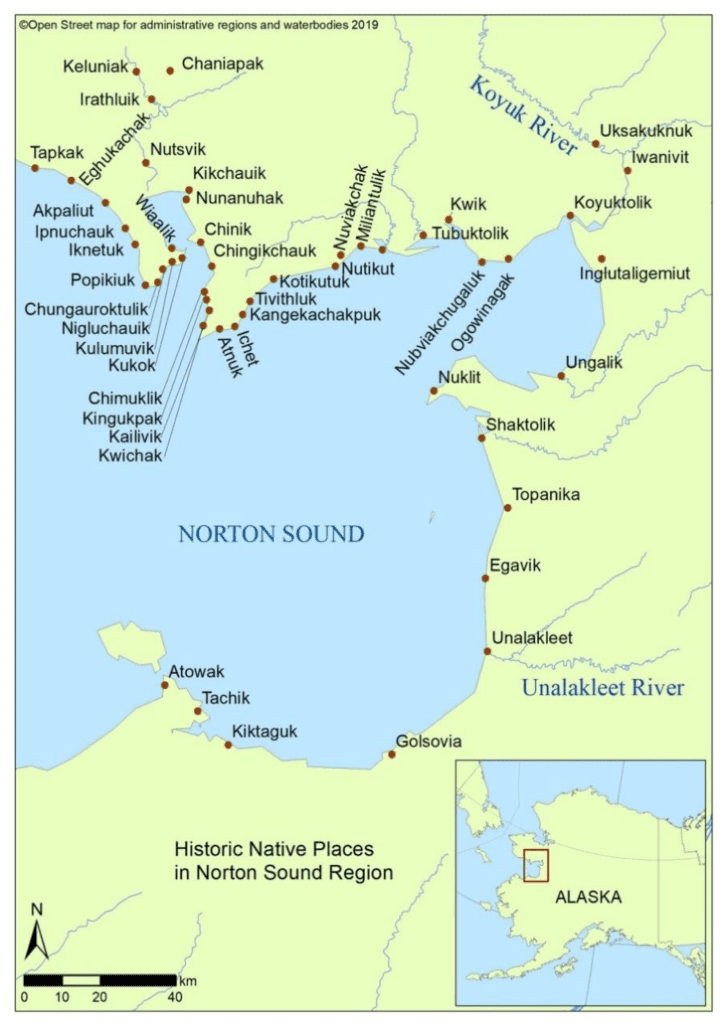
Unalakleet, Alaska
Caribou has long been one of the most important cultural and subsistence animals for the Indigenous People of Unalakleet, Alaska, a coastal community on the Norton Sound with Iñupiaq, Yupiaq and Athabascan heritage. Unalakleet is a central community for the Bering Strait region. Snowchange Cooperative has been working with the local Indigenous knowledge holders since 2002. Caribou is mentioned often, and people have reported many changes in the populations, hunting, distance to travel to areas used, health of the animals and so on. Additionally, reindeer herding was introduced in Unalakleet in the early 1900s, which has been influencing the stocks.
First Nations knowledge holders linked to the Fortymile Caribou herd, Yukon, Canada: Fairbanks, Alaska
The Fortymile herd is one of Alaska and Yukon’s most historically significant migratory caribou populations. Once numbering in the hundreds of thousands in the early 20th century, the herd ranged across a vast area of more than 200,000 km², from the boreal uplands west of Fairbanks to the mountains near Whitehorse. These long-distance movements have long supported the cultural traditions, food security and livelihoods of Indigenous communities across the region.
After a dramatic decline in the mid-1900s, the herd has shown signs of recovery in recent decades thanks to coordinated management actions. At the same time, new research is revealing how shifting habitat conditions, harvest pressures, and changing migration routes are reshaping the herd’s dynamics.
Gwich’in Climate Events Database, Alaska, United States of America
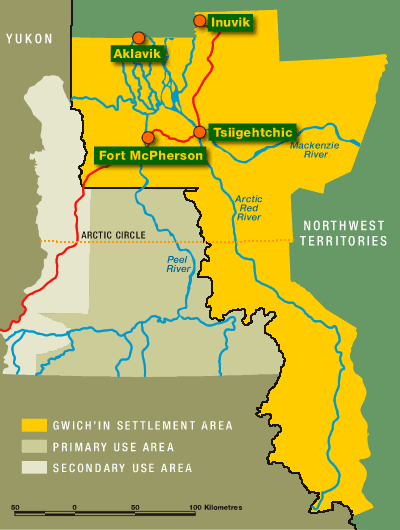
Settlement region of the Gwich’in © Gwich’in Social and Cultural InstituGwich’in Climate Events Database
The Gwich’in are one of the most northerly Indigenous peoples of North America, living at the northwestern edge of the boreal forest. They are part of the Athapaskans family of Indigenous Peoples. At the time of contact with Euro-Canadians, their territory extended from Alaska’s interior across the Yukon and into the Mackenzie Valley. Today, most Gwich’in live in the communities of Fort McPherson, Tsiigehtchic, Aklavik and Inuvik, though many families continue to use seasonal camps outside their communities. Hunting, fishing and trapping are still central to the community, both culturally and economically, with caribou, moose and whitefish being key staples of the Gwich’in diet.
The oral histories shared here come from a collection of testimonies from Gwich’in Elders and reflect their observations of climate, ecological and cultural changes across their traditional territory, from the 1900s to present day. This collection was curated by Prof. Leslie McCartney, an anthropologist and long-term research partner of the Gwich’in Tribal Council Department of Culture and Heritage, on behalf of the Gwich’in Tribal Council Department of Culture and Heritage. This database categorises data from the vast archives of Gwich’in oral history and ecological knowledge. Prof. McCartney and University of Michigan research intern, Nolan Loftis, reviewed transcripts, coded caribou events into an “event database” categorised by decade.
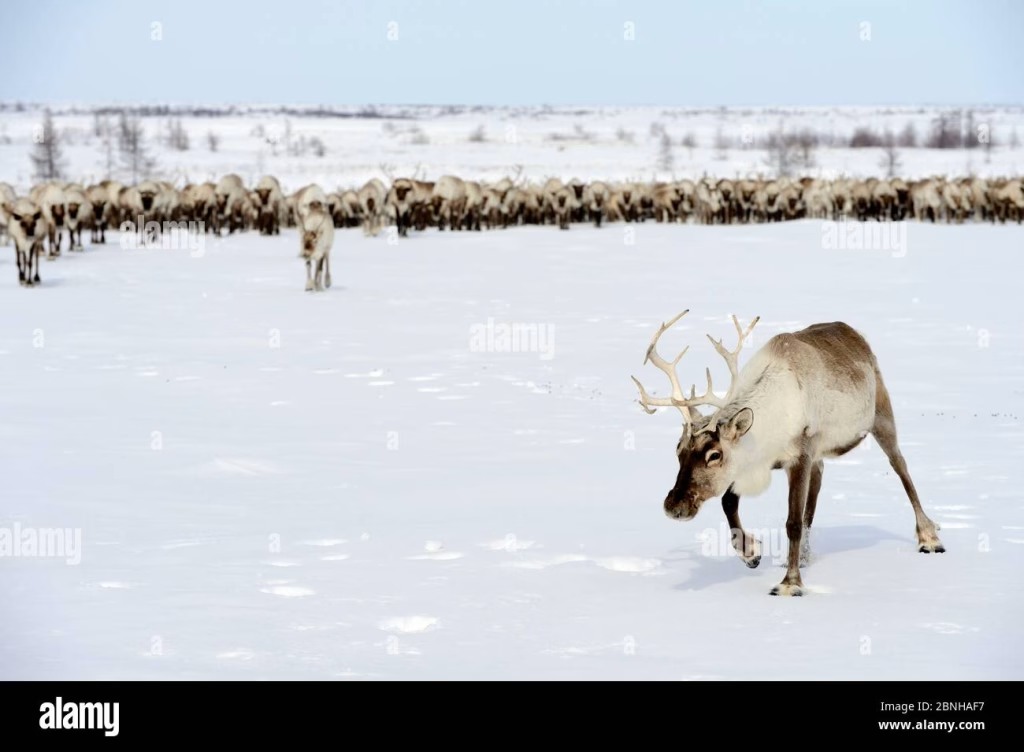
Iyengra Evenki, Southern Sakha-Yakutia, Siberia
The Evenki’s homelands stretch across a huge area of northern Asia, including eastern Siberia, the Russian Far East, northern China and parts of Mongolia. Their total population today is estimated at around 36,000. Traditionally, their livelihoods have centred on mobile reindeer herding, hunting and fishing, and these practices continue in many taiga camps.
The oral histories provided here focuses on the Evenki of Iyengra, a village in southern Sakha–Yakutia established in the Soviet period along historic migration routes. Many Evenki families still spend much of the year in the forest herding reindeer, while children attend the boarding school in Iyengra during the winter months. According to the latest publicly available census (2018), the village has just under a thousand residents, the majority of whom are Evenki, alongside smaller numbers of Even, Karelian, Russian and Sakha–Yakut inhabitants.
Over the past century, the Evenki landscape has undergone major transformations. Soviet and post-Soviet industrial expansion — including coal and gold mining, pipelines, hydropower projects and other infrastructure — has left a heavy footprint across southern Yakutia, reshaping ecosystems and restricting the movements of both people and wildlife. Many Evenki were resettled into Iyengra during Soviet consolidation policies, reducing the autonomy of traditional nomadic life.
Reindeer remain at the heart of Evenki culture, identity and subsistence. Both domestic herds and wild forest reindeer (various local forms of Rangifer tarandus) are essential for food security, mobility, social organisation, spiritual beliefs and ecological knowledge. Oral histories describe longstanding rules for respectful hunting, including practices for handling bones to honour the spirits of the taiga. The Evenki language encodes an exceptionally rich vocabulary for reindeer — dozens of core terms and, with dialectal variations, hundreds of expressions that distinguish age groups, sex, behaviour, colouring, temperament and states of domestication or wildness.
Industrial pressures and landscape fragmentation are now severely affecting wild reindeer populations in southern Sakha–Yakutia. As migration routes are disrupted and habitats are lost, these animals are retreating from areas they once occupied, posing challenges for the continuation of traditional Evenki lifeways and knowledge systems.
Oral Histories
Oral histories from Arctic Indigenous People offer first-hand insights into climate and environmental changes. When combined with scientific monitoring data, they provide a fuller understanding of local impacts, causes, and future implications of climate change from both scientific and traditional perspectives. Each oral history provided here contains critical first-hand accounts of traditional ecological knowledge on caribou/reindeer herds from Arctic Indigenous People, dating from the 1900s to the present.
We have included oral histories from the Indigenous Peoples of the Gwich’in (Canada), Unalakleet (Alaska), Kainuu (Finland) and Evenki (Siberia) and First Nations knowledge holders connected to the Fortymile caribou herd (Alaska-Canada) which are linked to the map above. Some key observations taken from the oral histories and their significance is shown as a pop up where relevant.
1910s
Aklavik was established as a fur-trade post in 1912, is located on the Peel Channel of the delta, and is surrounded by numerous lakes and swamps. It had a population of 689 in 2002, 24% of which are of Gwich’in ancestry {1595}. The Gwich’in residents of Aklavik call themselves the Ehdiitat Gwich’in, which translates as ‘delta people.’ Aklavik is also located in the Taiga Plains, and is on the dividing line between the Gwich’in Settlement Area and the Inuvialuit Settlement Region. It is in close proximity to the Richardson Mountains where people hunt Dall sheep and caribou.
1940s
Alestine: Yeah. Okay. How about animals that hunt other animals, like wolves, and this, again in this area when you stayed here in the 1940s.
Jim: Long time ago now, today there’s lots of caribou around here. Mostly moose into Mackenzie River. A long time ago there was, they go back in here, back here, Anderson River most part. Then they turned back. Now today they go way down here. But that time we never hardly see wolf around here in, where I was in Loucheux Lake. We never hardly see wolves. They stay mostly where the caribou are.
Alestine: So then moose, the wolves would stay near the caribou?
Jim: Yeah, mostly, that’s where they are. But us Dene people, the caribou and the wolf are doctor, something like that, just like doctors. So if the wolves don’t get after the caribou, the caribou will die off. That’s what they live on. That’s why lot of caribou stay alive. But no more wolf. Caribou stay alone and they’re going to die off, they going to have strong sickness, yeah. Tape 80 Jim Pierrot.
Transcripts from GW TK Study of the Mackenzie Gas Project Area, December 6, 2004 p. 9.
1950s
Liz: Um…what about caribou and moose? Are they still same, more or less or…?
Lucy: More, more. Liz: More moose?
Lucy: More moose and more caribou. Long ago when I first got married, there was no caribou…for…in the 60’s I guess, 50-something, caribou start coming. Before that I never seen caribou; lotsa moose though. Jimmy kill lotsa moose but them days you’re not supposed to kill cows, hah? It was just straight bulls you’re supposed to kill. Game warden used to make his patrol around, see if anybody killed a cow moose. But you always hide the head, anyway, you know.
Tape 58 Lucy Adams. Transcripts from GW TK Study of the Mackenzie Gas Project Area, November 22, 2004 p. 3, 4.
2000s
Currently, most Gwich’in spend time on the land in the form of weekends or winter or summer trips although they do not spend as much time as they used to, their connection to their traditional lands and lifestyle is still very strong. Caribou, whitefish, coney, moose, and scoter (black ducks) are the five most often consumed food, with caribou being consumed, on average, more than three times per week (Van Oostdam, J., et al 2003: 12 {1596}). Tracy Campbell (1996) notes that for Aboriginal communities such as the Gwich’in, hunting, trapping, fishing and other traditional activities “relate more to issues of culture, lifestyle, and identity than to questions of economy, although economic considerations cannot be minimized.”
Gwich’in Traditional Knowledge Study of the Mackenzie Gas Project Area. Inuvik: Gwich’in Social & Cultural Institute, 2005, p. 18.
There used to be many caribou at Khaii luk, and mentions that caribou change their behaviour in response to forest fires. {T17} Some community members mentioned that they have to arrange community hunts to other places such as Tuktoyaktuk to get caribou these days, due to changing migration patterns.
{1576} Gwich’in Traditional Knowledge Study of the Mackenzie Gas Project Area. Inuvik: Gwich’in Social & Cultural Institute, 2005, 101.
The state and changes in permafrost are best noted in the spring and summer, when people are using the ground to store food in as a freezer, or noticing slumping from either rainfall or melting permafrost during their travels. Fred Joe from Aklavik told the Berger Inquiry of some problems with development that might occur in the fall, based on an experience they had with a culvert on Rengleng River. A culvert was installed to allow a stream and the fish to traverse under the road and was gravelled into place by developers. The culvert collapsed in September. He also mentioned that caribou and moose will cross a cutline but when the gravel pad for the Dempster Highway was installed, the animals would not climb over it in the beginning.
{1606 v2} Gwich’in Traditional Knowledge Study of the Mackenzie Gas Project Area. Inuvik: Gwich’in Social & Cultural Institute, 2005, 151.
“From spring to summer, summer to fall—whether there was any change that you noticed? Yeah, it’s…there’s quite a few change in the weather like that, too. Because like I told you…the weather used to be colder, starting in October. But now it’s not like that. Like (pause) sometimes it’s too cold to go out; too cold to hunt. It’s never cold to trap, but for hunting it’s different thing—hunting moose and hunting caribou—it’s a different thing, too. But uh…them days, you know what day to pick. If it’s warm, well you know it’s warm enough to go hunt moose but if it’s too cold, you can’t hunt moose, uh? Moose could hear you, maybe two, three miles away, but when it’s warm it’s different. You could walk around slowly and you…sometimes you have to take off your snowshoes to walk after moose, because snowshoes make more noise, uh? Yeah, sometimes you’ve got to walk about a mile or two without snowshoes. Sometimes, it’s pretty deep snow, but you’ve got no other choice; you’ve got to do it that way. (pause) You got to be a good hunter like that…the snow and the weather, all got to match together so you…you know which weather to hunt moose and you know which weather to hunt caribou, or (pause) but trapping is different; it doesn’t have to have warmer or colder weather. (pause) Same with fish…you want to check your net— you usually have net out there all winter—we used to have net in the lake, uh?
Tape 1 Gabe Andrew. Transcripts from GW TK Study of the Mackenzie Gas Project Area, November 1, 2004, p. 7 & 8.
Lot of the moose, they got warts now. Caribou got warts. Some of their insides is not as good. Their flesh and their meat is really glossy now, used to never be that glossy. More darker red, now it’s lighter red. (pause) Um, marrow, marrow don’t taste like it used to, it’s all, used to be really um, like had a sweet taste to it and now it’s got like a bitter taste and it’s solid. It’s not as flexible as it used to be.
Tape 8 Anna May McLeod. Transcripts from GW TK Study of the Mackenzie Gas Project Area, November 3, 2004, p. 9.
The only caribou, I notice some uh (pause) some of the liver is not too good and the lungs side. And the same with that muskrat is like that too.
Tape 40 Allan Koe. Transcripts from GW TK Study of the Mackenzie Gas Project Area, November 17, 2004 p. 4.
“I don’t see that much ptarmigans anymore. Maybe it’s because we haven’t had caribou around for quite a while… this year is one of few years that they can down, eat to hills, up here. Probably because the areas where they go is burnt out. Kristi: Mmm. (pause) So ptarmigans and caribous… Thomas: They’re usually together. Thomas: That what, I know my, the older people…like my parents they used to watch for that, if there’s… start seeing lots of ptarmigan come around well they get ready. You know, to hunt caribou. Not that much[ptarmagin] this year. I never seen none this year.
Tape 41 Thomas Stewart. Transcripts from GW TK Study of the Mackenzie Gas Project Area, November 17, 2004 p. 36, 37.”
[Crows] I notice that this fall they left town for a little while. Dale: Yeah. That’s when everybody was hunting caribou around the hills. Thomas: There were all gone. Now they get feed off something different than garbage eh? They’re around. Seagulls too they’re a scavengers, didn’t, don’t see that much of them around anymore. Usually [unclear] like I was up at the islands… um, fishing, making dry fish, ah, try to make. Usually they’re all around your camp but this year’s there was nothing. Last couple a years there were hardly anything around. (pause) Don’t see them around the nets or anything anymore.
Tape 41 Thomas Stewart. Transcripts from GW TK Study of the Mackenzie Gas Project Area, November 17, 2004 p. 39, 40.
Kristi: Neil, do you think people are as healthy now as they were when you were a kid? (pause) Are they more healthy?
Neil: No, no, no, no. Absolutely no. Because they’re sitting around; they got…government give them a house to stay in, uh? You got furnace and you got fridge and you got TV and you don’t do much. You know in a building you have that thing…they’ve got gyprock inside. I heard that gyprock is no good for health. People don’t like it because…your body…you’re living in there where it’s gyprock and then hardly any plywood and you’ve got furnace making noise and you don’t hardly do anything. Out in the bush you’re forever moving, cutting wood and you’re walking and …fresh air. You cut wood and you go for caribou and cut meat—you’re always doing something. And that’s part of your life and you keep healthy. But nowadays it’s…so many things change, eh? Like too much junk food in store and too much…life change. Like too much alcohol, too much drugs interfere with the people and all that…things what we do is interfering with our health. Because somebody’s knocking, three or four o’clock in the morning and…because that person is drugged up or drink alcohol, it’s interfering with your sleep. You’re supposed to have a good rest and somebody’s yelling their head off with skidoo or something. It’s not like it used to be; used to be no alcohol, no drugs and everything’s quiet. Just hear dogs barking once in awhile, good health all the time and you’re working. But now, today, it’s different. And all over in Yukon, Alaska, people, they tell me the same thing in Alaska. Life change all over.
Tape 51 Neil Colin. Transcripts from GW TK Study of the Mackenzie Gas Project Area, November 19, 2004 p. 4.
Sarah: The other day, I wanted caribou meat and I phoned around and they all want money.
Kristi: People just don’t share? Sarah: No, some of them do, but… Liz: They don’t share like they used to?
Sarah: No, no. Yeah, so this good friend of mine too, he said, ‘I can’t give away meat.’ But I told him, ‘Well, what about when I get my old pension; I’ll buy meat off you.’ ‘Oh yeah, sure.’ But I’m not going to.
Tape 53 Sarah McLeod Frith. Transcripts from GW TK Study of the Mackenzie Gas Project Area, November 22, 2004 p. 18.
Liz: There seems to be more caribou, more moose, more like grasshoppers and beavers?
Lucy: Yeah, beaver too, lots, yeah. Liz: Anything else increase in number over the years, you think? Remember a few years ago, there used to be seals swimming around in here. Lucy: It used to be, yeah. And [oguyuk] now last three years ago, there was an big [oguyuk]. John Coyen and Bobby Gully killed it up there. Put big holes in our nets and everything. My, he’s big! it’s real big; it weighed about a thousand, over a thousand pounds. George said he see…he said it was ahm…
Liz: She means using the word [Oguyuk].
Tape 58 Lucy Adams. Transcripts from GW TK Study of the Mackenzie Gas Project Area, November 22, 2004 p. 6.
Beaver? Oh, yeah. This is one of the prime beaver areas, in here, oh hell yeah. From Tsiigehtchic that’s why they were big-time beaver trappers. Oh, yeah, they’re everywhere.
Alestine: Because they’re on every lake just about?
Willard: Yeah, because there’s nobody trapping anymore, before they used to go there…but they knew, I mean, they used to clean out—except for the female—they’d always try to leave the big male, and take everything else that they can. And then they usually come back, but they keep the population down. No, they’re everywhere now. You know, they never see to be around any big lakes, if you notice, they’re always like a chain of lakes, and all shallow—shallow area—like there’s a lot by Sitidgi Lake…well, not Sitidgi Lake itself, but that river system. So, they seem to be more in ponds and small little lakes; you very seldom see them in the big lakes. Any wet area, like there’s a lot of beavers through Caribou Lake—this area over this way. A lot of beavers. And around Cardinal Lake—this area through here—there’s a lot of beaver because of the smaller lakes and little creeks. That’s what it seems like. You never see them dam big rivers, or you know…but uh…smaller creeks, for sure. They’re in a lot of the creeks.
Tape 60 Willard Hagan. Transcripts from GW TK Study of the Mackenzie Gas Project Area, November 23, 2004 p. 16, 17.
Kristi: Do you think that keeps you healthy, eating country foods?
Willard: Well, if you know…I guess there’s more and more contaminants getting into it, but I think it’s still healthier than force-fed beef and chicken, and uh…if not, physically healthy, it’s spiritually and mentally, I think it’s good for you. I still think it’s healthier than processed foods, for damn sure. It’s probably healthier…I know doctors that say you can eat caribou every day if you want to.
Tape 60 Willard Hagan. Transcripts from GW TK Study of the Mackenzie Gas Project Area, November 23, 2004 p. 19.
[Rabbits] Boy, some of them are no good. Yeah.
Liz: Skinny?
John: Yeah. Because if the lakes are dry, and the grass too is no good too in there. You see the moose and the caribou—caribou they eat good, way out mainland, ah?—something fresh all the time. The delta, some of them, dry willows sometimes, and that grass is no good too. Kristi: In the delta? John: Yeah, getting dry; no water. And just like it’s dead and get…it’s um…it’s like rusty or something. But when you paddle down, you could see the water like blue, you know, some lakes. On the shore, too, on the shore, uh? Like the Mackenzie on the shore, in the delta, I mean. In the creeks, boy, one side, see different color.
Tape 73 John Jerome. Transcripts from GW TK Study of the Mackenzie Gas Project Area, November 26, 2004 p. 2, 3.
Liz: I’m going to ask you a question that’s not on this paper and that’s—do you think more people will hunt the caribou in this area once that pipeline road goes through?
Fred: Yeah. They’ll be a lot of them following that pipeline. And uh, just like last year, they’re…all the caribou was all the way down to this area here and they…people hunt all over around here last year. Yeah, because there’s a good road.
Tape 75 Fred B. Jerome. Transcripts from GW TK Study of the Mackenzie Gas Project Area, November 26, 2004 p. 2.
Cougars, moving in. And muskox are going to take over the whole area. Muskox are discovered way up at Fort Good Hope now. I asked um…them boys about it and they said there’s only one herd out there. I said, ‘No, there’s two or three herds I’ve seen.’ They couldn’t believe me. They’re going to take over that…caribou…
Tape 75 Fred B. Jerome. Transcripts from GW TK Study of the Mackenzie Gas Project Area, November 26, 2004 p. 7.
Iyengra Evenki Oral Histories
“Spring is the season of a new life. New calves come into this world. For us, for Evenki, this is the happiest and the most exciting season. Reindeer calving is very important for it increases the number of reindeer. There are domestic and wild reindeer. Today we will talk about hunting of wild reindeer. In past, long time ago when I was a child, out reindeer herd was located about 110 kilometres away from the settlement. An all-terrain-vehicle delivered food two or three times a year. That is why, our main food was wild reindeer meat. There was enough wild reindeer in the area both for us and for other predators (wolves, bears, etc). There was enough wild reindeer. We harvested as much as Seveki1 would give us—Evenki do not take too much, they have to share with others—‘Nimat’2. Sometimes in the morning you would come out of your tent and reindeer were going in circles and were jumping away from something within kure3 —turned out that a wild reindeer came with domestic reindeer. Nowadays, it does not happen often. In the course of time, the climate has changed—fires, droughts. Because of the fires the number of wolves and bears has grown; they have chased away wild reindeer and got at our domestic reindeer. We had to move closer to the settlement. At present there are horrible times for reindeer herders. Gold-diggers are everywhere, destroying the land. But reindeer have to eat lichen and drink clean water. Everywhere is the noise of machines, there are no wild reindeer left, they migrated to pristine areas. Because there is no wild reindeer, Evenki food supply is disrupted. In summer, if you are lucky, you can harvest one wild reindeer and the probability of it is 1 to 100. And in winter, reindeer herders go away for a month in order to harvest some meat for their families. When gold-diggers have appeared, nothing alive was left in the forest.”
Anonymous female reindeer herder
First Nations, Fortymile Caribou Herd Oral Histories
“Most First Nations People that have been connected to the Caribou have been so for their whole lives. Because they were such a consistent and important part of our lives, we would never want to see their numbers fall or their health and place on the land jeopardised, but others don’t have the same kind of connection. If the Caribou disappears for them, it doesn’t mean the same. Their whole lives were not built around respecting and living with the caribou.”
Elder Charlie James
“You don’t try to change them in any way at all. If you look after them, because that’s what the Creator wants you to do, then in a roundabout way, the Caribou will look after you too, and the whole land, everything will look after you. And sometimes when you’re out in the woods, you can see that, you can tell.”
Norman Adamson
“…long time ago, when you get the, … when they got a caribou and that caribou, they save all the sinew from the caribou. They do like this, and they have a spool like a yarn, eh? You save it, so you can use it; you could sew with it.”
Elder Irene Adamson
“This one here was made out of caribou horn, this knife, eh? Made out of caribou horn. […] This is the caribou back leg, used to make, we put caribou skin over this one, and the hair side, you clean it, you scrape it off with this. […] this here, for snowshoe filling, made of caribou hide. Like front or back, you know, they fill the snowshoes with it. Made out of caribou.”
Elder Paddy Jim
“Like a, when a, when this, this place was flooded with … the gold seekers, when our uncle there, Skookum Jim, discovered gold down in Dawson. This place just, our wildlife was all over here. We lived with it, we all lived together, and … in less than a hundred years it’s gone. Like all the caribou, that Fortymile caribou herd used to come right here, right down to the [Lake] Laberge here, go right around. […] And now, it´s just a little bit on the Alaska border, just a little area there that they cover up. There was over a half a million caribou in that herd that come all the way, because, we, we talk to people at Carmacks, Pelly [Crossing] and around there, they said when those caribou come through, man they just come by the thousands. And dad was telling me he went down to, um, he took his hunting party right from here, all the way down to Kluane Lake, and Kluane Lake he stayed on this side and went down around […] Nisling River. … and then he come out at Carmacks. That’s a two months trip, that’s sixty days he´s travelling. And at Carmacks he put […] on the boat and coming back up, he says, the caribou were crossing there for about four to six hours there, they had to pull up because they couldn´t… the caribou was crossing the river ahead of them. […] I think this was about 1930, between about ’28 and ’34.”
Elder Art Johns
“I said, I was a year and seven months old when I left home and here, we went down, me and dad, went down to Carmacks in 1933, and… and that Twin Lakes […] right there. It used to be one big meadow just like this table and that place was just dug up with caribou, and that side hill there, you just see them, just like a rope, by the thousands. 1933, in, around February, yeah. Just was so many caribou.”
Elder Irene Adamson
“And, there’s different animals, that have been disappearing. We try to watch that ourselves, as First Nation people. Tlingit people. We watch the caribou population, the moose population. And we also watch the fish. We have been really watching the fish and we just take so many fish, like we allow one a day, that’s what we allow, we allow that for ourself too. And if we get the great big one, we put it back in the lake, and we just take the small ones. And we can see the difference, alright enough. There’s a difference it that now. You can see the population of trout coming up. Now, since we’ve been doing that. And the moose is in the same way, the caribou have been gone. But people aren’t killing caribou, we kind of let them go now – for the last five years or more in different areas, here we have let them go, till we see grow back the herd again.”
Elder Pearl Keenan
“Part of this hunt is this collaboration between elders, youth, community hunters – to be able to teach and learn.”
Lee Whalen
Unalakleet Oral Histories
“They showed up (again) about twenty years ago (1982), and we had an abundance of caribou here. In fact, you could see some migrate across the plateau. And there was so many you’re allowed to kill five caribou a day. But who was to kill five caribou per day? It’s all I need for winter, I mean for whole year maybe five caribous. And we make jerky out of them. And we put some in the freezer, cut them, up ready to eat.”
Elder Oscar Koutchak and his wife Mae
“You know, like the last couple of years, we haven’t had the caribou down here, like we did within the last decade. And, and we’ve adapted to that. You know, with alternative food sources.”
Steve Ivanoff
“My caribou steak tastes better than the beef, that’s sure and [the meat] has been aging for four months. My caribou meat, I take it out, and cut it up. And the first one I feed them, my dog. And the next one I cut up, they are all good. They are all red meat, and fresh, and real good meat.”
Jerry Ivanoff
“Beluga and caribou migrations have changed since 2002.”
Jolene Nanouk Katchatag
Unalakleet Oral Histories
Mustonen, T., Van Dam, B., 2021. Climate Change and Unalakleet: A Deep Analysis. Sustainability 13, 9971. Link
Mustonen, T., Mustonen, K., 2009. It Has Been in Our Blood for Years and Years that We Are Salmon Fishermen – A Book of Oral History from Unalakleet, Alaska, USA. Waasa Graphics Oy, Vaasa Finland. Link
Gwich’in Oral Histories
Website: Gwich’in Tribal Council, Department of Culture and Heritage and the Snowchange Cooperative, 2024. Gwich’in Climate Events Database. ArcGIS StoryMaps. Link
Website: Gwich’in Social & Cultural Institute, 2016. Gwich’in Social & Cultural Institute [WWW Document]. Gwichin Soc. Cult. Inst. Link
Full Gwich’in Events Database Link.
Fortymile Caribou herd oral histories
ADFG, 2023
Boertje, et al 2012
Davis et al, 1978
Murie, 1935
Southern Sakha-Yakutia oral histories
Arctic Council. (2013). Arctic biodiversity assessment. www.arcticbiodiversity.is
Argunov, A. Population Dynamics and Usage Dynamics of the Northern Wild Reindeer Resources in Yakutia 3. 2017. Available online: http://science-education.ru/ru/article/view?id=26526
Lavrillier, A. The creation and persistence of cultural landscapes among the Siberian Evenkis: Two conceptions of “sacred” space. In Landscape and Culture in Northern Eurasia; Jordan, P., Ed.; Routledge: London, UK, 2011; pp. 215–231
Lavrillier, A.; Gabyushev, S. An Arctic Indigenous Knowledge System of Landscape, Climate and Human Interactions: Evenki Reindeer Herders and Hunters; SEC Publications: New York, NY, USA, 2018; Available online: http://www.siberian-studies.org/publications/PDF/lavgab.pdf
Mustonen, T. (2022), Wild reindeer as a keystone cultural and ecological species in the Eurasian north. Glob Change Biol, 28: 4225-4228. https://doi.org/10.1111/gcb.16203
Mustonen, T., Andreeva, T., Shadrin, V., & Mustonen, K. (2021). Return of Nimat?—Wild reindeer as an indicator of Evenki biocultural systems. Sustainability, 13(21), 12107. https://doi.org/10.3390/su132112107
Speck, F. G. (1977). Naskapi: The savage hunters of the Labrador Peninsula. University of Oklahoma Press.
Varfolomeeva, A. Lines in the Sacred Landscape-The Entanglement of Roads, Resources, and Informal Practices in Buriatiia. Sibirica 2020, 19, 2
Vorob’ev, D. Contemporary Beliefs of Northern Wild Deer Hunters—(The Case of the Chirinda Evenki). Anthropol. Archeol. Eurasia 2014, 52, 34–58.
Yakovleva, N. Oil pipeline construction in Eastern Siberia: Implications for Indigenous people. Geoforum 2011, 42, 708–719.